
Open and Closed Syllables: A Parent-Friendly Guide for Teaching Reading at Home
If you are homeschooling and trying to help your child learn to read, you may have heard terms like open syllable, closed syllable, vowel sounds, and consonants. These ideas come from the Science of Reading and are used in structured literacy approaches like the Orton-Gillingham method.
The good news is this: you do not need a teaching degree to begin using these strategies at home.
This guide will walk you step by step through:
Identifying vowels and consonants
Marking words with your child
Understanding open and closed syllables
Knowing why vowels make different sounds
Practicing with simple examples you can use right away
Step 1: Teach the Difference Between Vowels and Consonants
Before a child can understand syllables, they must know the difference between vowels and consonants.
The Vowels
The vowels are:
a, e, i, o, u
Sometimes y acts like a vowel too.
Important Rule
Every syllable must have a vowel.
A vowel can make:
a short sound
a long sound
Examples:
short a = /a/ as in cat
long a = /ā/ as in baby
The Consonants
All the other letters are consonants.
Examples:
b
t
m
s
p
Consonants usually “close in” or surround vowels.
Step 2: Teach What a Syllable Is
A syllable is one beat or one mouth push in a word.
Examples:
cat = 1 syllable
robot = 2 syllables
fantastic = 3 syllables
Easy Practice
Have your child clap the syllables:
table = 2 claps
pencil = 2 claps
baby = 2 claps
Step 3: Teach the Two Most Important Syllable Types First
In the Science of Reading, children learn six syllable types. The first two are:
Closed syllables
Open syllables
These two types help children understand why vowels sometimes say their short sound and sometimes say their long sound.
Step 4: Understanding Closed Syllables
A closed syllable has:
one vowel
followed by one or more consonants
The consonant “closes in” the vowel.
When this happens, the vowel usually says its short sound.
Examples of Closed Syllables
WordVowel Soundcatshort abedshort epigshort ihotshort osunshort u
How to Mark a Closed Syllable
Use these simple steps with your child.
Example Word: cat
Step 1: Find the vowel
c a t
Step 2: Underline or scoop the syllable
cat
Step 3: Notice the consonant after the vowel
The t closes the syllable.
Step 4: Say the vowel sound
Because the syllable is closed, the vowel says its short sound:
/a/
Parent Script
You can say:
“The consonant closes the vowel in, so the vowel says its short sound.”
Keep the language simple and consistent.
Step 5: Understanding Open Syllables
An open syllable ends with a vowel.
There is no consonant closing it in.
When a syllable is open, the vowel usually says its long sound.
Examples of Open Syllables
WordVowel Soundmelong egolong ohilong ishelong eba-bylong a in first syllable
How to Mark an Open Syllable
Example Word: go
Step 1: Find the vowel
g o
Step 2: Notice the syllable ends with the vowel
Nothing closes it in.
Step 3: Say the vowel sound
The vowel says its name:
/ō/
Parent Script
You can say:
“The vowel is open, so it can say its name.”
Step 6: Teach Children to Look at the Letter After the Vowel
This is one of the most important reading habits.
Teach your child to ask:
“What comes after the vowel?”
If a consonant comes after it:
The syllable is usually closed.
The vowel is usually short.
Example:
nap
sit
hop
If nothing closes it in:
The syllable is usually open.
The vowel is usually long.
Example:
he
go
flu
Step 7: Practice with Two-Syllable Words
Once your child understands one-syllable words, move to longer words.
Example: robot
Break the word into syllables:
ro | bot
First syllable: ro
ends in a vowel
open syllable
o says long /ō/
Second syllable: bot
vowel followed by consonant
closed syllable
o says short /o/
Another Example: baby
ba | by
First syllable: ba
open syllable
long a
Second syllable: by
y acts like a vowel
says long /ī/
Step 8: Teach the Six Syllable Types Slowly
Children do not need to master all six syllable types at once. Start with open and closed syllables first.
Here are the six syllable types used in structured literacy:
Syllable Type
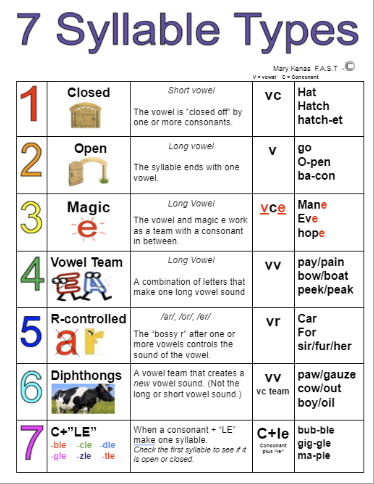
For beginning readers, focus mostly on:
closed syllables
open syllables
These build the foundation for everything else.
Step 9: Simple Daily Practice
You only need 10–15 minutes a day.
Practice Routine
1. Review vowels and consonants
Ask:
“Which letter is the vowel?”
“Which letters are consonants?”
2. Read short words
Examples:
Closed:
map
pet
fin
hot
cup
Open:
me
hi
no
she
3. Mark the syllable type together
Ask:
“Is the vowel closed in?”
“Does the syllable end with a vowel?”
4. Say the vowel sound
Help your child connect:
closed = short vowel
open = long vowel
Step 10: What to Do If Your Child Struggles
Many children need repeated practice before this becomes automatic.
That is normal.
Keep lessons:
short
calm
predictable
repetitive
Avoid rushing.
Children learn best when they can:
see it
say it
hear it
write it
This is one reason the Orton-Gillingham approach is so effective. It uses multisensory learning to strengthen reading pathways in the brain.
A Simple Way to Explain It to Your Child
You can summarize open and closed syllables like this:
Closed Syllable
“A consonant closes the vowel in, so the vowel says its short sound.”
Example:
cat
bed
hop
Open Syllable
“The vowel is open, so it says its name.”
Example:
go
me
hi
Final Encouragement for Parents
You do not need to teach everything at once.
Reading develops step by step.
When children learn how syllables work, reading becomes more predictable and less confusing. Instead of guessing at words, they begin using patterns.
That is the heart of the Science of Reading.
Start simple.
Practice consistently.
Celebrate small wins.
Even a few minutes each day can make a tremendous difference over time.
