
Have you ever watched a child solve an addition problem correctly, only to struggle when they see a subtraction problem using the same numbers? Sometimes, children learn to solve individual problems without realizing how closely those problems are connected.
This is one reason fact families are such an important part of building number sense. When children understand how numbers work together, they begin to see that math isn't a collection of separate facts to memorize. It's a set of relationships they can use to solve problems.
What Is a Fact Family?
A fact family is a group of related addition and subtraction equations that use the same three numbers.
Let's look at the numbers 3, 4, and 7.
Our fact family:
3 + 4 = 7
4 + 3 = 7
7 − 3 = 4
7 − 4 = 3
Notice that the numbers stay the same, but the operation and the order of the numbers change.
Addition combines the two smaller numbers to make the whole. Subtraction starts with the whole and takes away one part to find the other.
When children recognize this relationship, they have more than four facts to memorize. They have an understanding they can use to figure out an answer, even when they don't immediately remember it.
Connecting Fact Families to Number Bonds
In our recent blogs, we've explored part-part-whole relationships and how number bonds and number lines help children understand numbers. Fact families build directly on those ideas.
A number bond shows how two parts combine to make a whole. In our example, 3 and 4 are the parts, and 7 is the whole.
7 is the whole. 3 and 4 are the parts.
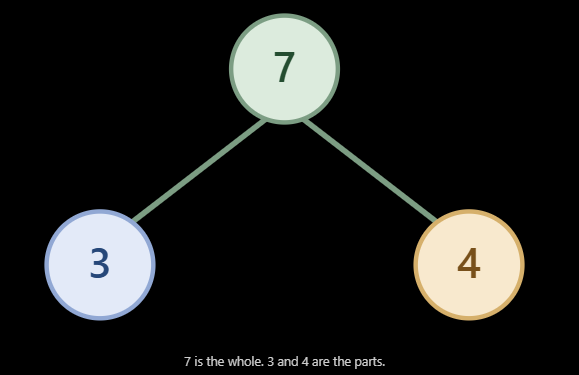
Once children understand this relationship, they can use it to write all four equations. If they know the whole is 7 and one part is 3, they can figure out that the missing part is 4. They can also recognize that subtraction is another way to explore the same relationship.
This is why the tools we've been discussing work so well together. Number bonds help children see how numbers are composed, number lines help them visualize the distance between numbers, and fact families help them connect addition and subtraction.
Each idea reinforces the others.
How Can We Practice Fact Families at Home?
You don't need worksheets or special materials to help your child practice. A few everyday objects and some thoughtful questions can go a long way.
Use small objects. Gather seven buttons, blocks, coins, or other small items. Separate them into two groups, perhaps three and four. Ask your child how many there are altogether. Then explore what happens when you start with all five and take away one group.
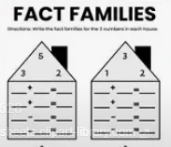
Draw a fact family house. Write the numbers 3, 2, and 5 in a small house or triangle. Have your child use those numbers to create two addition and two subtraction equations. Talk about why each equation belongs to the same family.
Look for missing numbers. Try a problem such as 3 + ___ = 5. Rather than immediately telling your child what to do, ask, "What do you know? What are you trying to find?" Your child might count up, use a number line, or think about 5 − 3. Encourage them to explain their thinking.
Mix up the equations. Write the four equations from the fact family on separate pieces of paper. Ask your child to sort them into addition and subtraction, then explain how the equations are connected.
The goal isn't speed. It's helping children understand why the answers make sense.
E3 Takeaway
Fact families help children recognize that addition and subtraction are connected. When children understand how three numbers relate to one another, they can use what they already know to solve new problems.
As parents, we can support this understanding by asking questions, using everyday objects, and giving children time to explain their thinking. When we focus on the relationships between numbers instead of memorizing isolated facts, we help children build a stronger foundation for future math learning.
From the Teacher's Desk
One of my favorite parts of teaching math is watching a child begin to make connections. A problem that once seemed unfamiliar starts to make sense because the child recognizes something they already know.
That is what we're working toward: children who can think about numbers, make connections, and choose a strategy that works for them. We don't want them simply to remember an answer. We want them to understand why it works and feel confident using that understanding again.
At E3 Learners, we believe that building strong foundations takes time, practice, and opportunities to make meaningful connections. Each new skill gives children another tool they can carry with them as they grow.
