
Last Saturday, we explored unknown numbers and how part-part-whole relationships can help children figure out a missing number. This week, we are going to build on that understanding by introducing two tools that work beautifully together: number bonds and number lines.
Both help children see how numbers relate to one another, but they show those relationships in different ways. When children learn to use them together, they can develop a stronger understanding of addition, subtraction, and missing-number problems.
What Are Number Bonds?
Number bonds are a visual way to show how two or more parts come together to make a whole. They help children see that numbers are connected rather than just separate facts to memorize.
For example, 8 can be made from 5 and 3. We can show 8 as the whole and 5 and 3 as the two parts. Once children understand this relationship, we can change the problem by leaving one part blank and asking them to figure out what is missing.
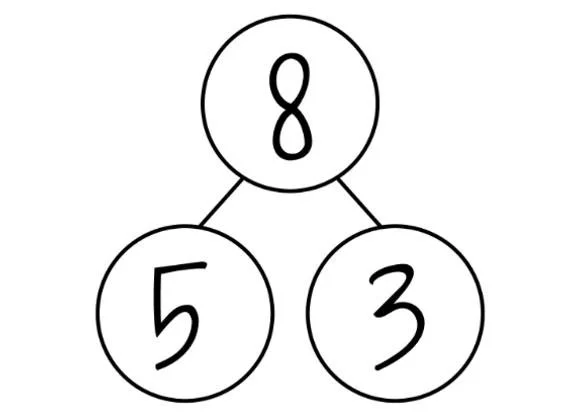
5 + 3 = 8
5 + ___ = 8
___ + 3 = 8
8 - 5 = ___
These are not four unrelated problems. They all describe the same relationship between the numbers!
This is especially important because children sometimes become comfortable finding the whole but struggle when they are asked to find a missing part. Practicing both situations helps them understand what the numbers represent and what the problem is asking them to find.
Introducing Number Lines
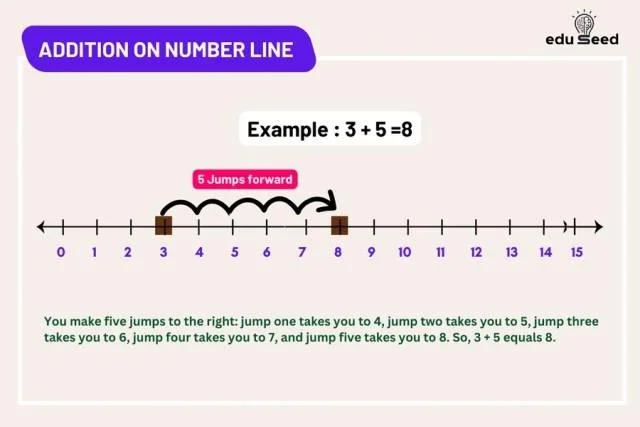
A number line gives children another way to see how numbers relate to one another. Instead of looking at numbers in circles, they can see how numbers move forward and backward along a line.
When adding, we move forward. When subtracting, we often move backward. The size and direction of the jumps help children visualize what is happening in the problem.
Let's use our example of 5, 3, and 8.
To solve 5 + 3, a child can start at 5 and make three jumps forward. They land on 8.
To solve 8 - 5, a child can start at 8 and make five jumps backward. They land on 3.
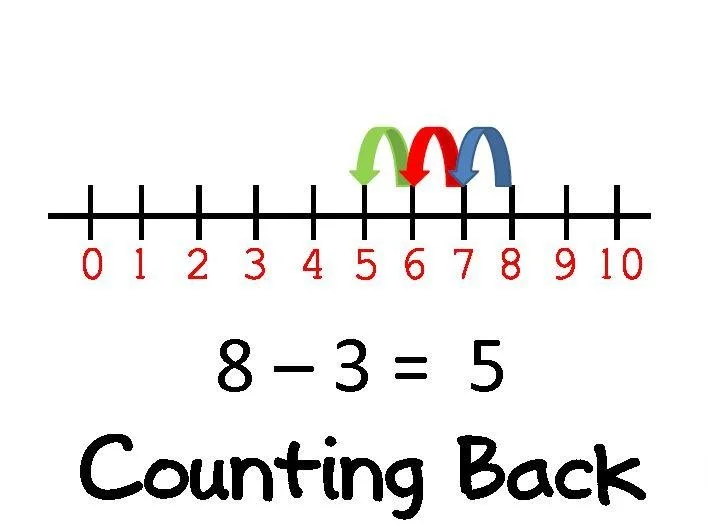
We can also use the number line to solve 5 + ___ = 8. Start at 5 and move forward until you reach 8. How many jumps did you make? Three!
A number line can also help children understand subtraction as finding the difference between two numbers. Rather than simply memorizing that subtraction means taking away, children begin to see how far apart two numbers are.
Putting Number Bonds and Number Lines Together
This is where the learning gets exciting! We can use both tools to help children understand the same problem in different ways.
Let's say we ask a child to solve:
8 - ___ = 3
First, we can use a number bond to show that 8 is the whole. We know one part is 3, but the other part is missing.
Next, we can use a number line. Start at 3 and count forward until you reach 8. The number of jumps tells us the missing part.
We count five jumps, so the missing number is 5.
Notice that we started with a subtraction problem but used addition on the number line to find the answer. This is an important connection for children to make! When finding a missing number, they can use either addition or subtraction, depending on which strategy makes the most sense to them.
For example, with the problem 8 - ___ = 3, a child might start at 8 and count backward three jumps to find 5. Another child might start at 3 and count forward to 8, discovering that five jumps are needed. Both strategies work.
The goal is not to teach children that they must always use one operation or the other. Instead, we want them to understand the relationship between the numbers so they can choose a strategy that works for them.
We can write the related equations:
3 + 5 = 8
8 - 3 = 5
8 - 5 = 3
The number bond helps children identify the relationship between the whole and its parts. The number line helps them see the distance between the numbers. Together, these tools encourage children to think about what the numbers mean instead of relying only on a memorized rule.
Easy Ways to Practice at Home
You do not need a special math curriculum or fancy materials to help your child practice these skills. A pencil and paper, a whiteboard, or even a number line drawn on the sidewalk can work!
Here are a few simple activities to try:
Build a number bond. Choose a number such as 6, 8, or 10. Ask your child to find two parts that make the whole. Then switch it around and leave one part blank.
Draw a number line. Write the numbers from 0 to 10. Give your child an addition or subtraction problem and ask them to show their thinking with jumps.
Find the missing number. Try problems such as 4 + ___ = 7, 9 - ___ = 5, or ___ + 2 = 6. Ask your child to explain how they figured it out.
Connect the tools. Solve one problem with a number bond and then use a number line to show the same relationship. Talk about what is the same and what looks different. Can your child find the missing number using both addition and subtraction?
Let your child explain. Ask, "How do you know?" or "Can you show me another way?" These questions give you a glimpse into your child's understanding and help them develop confidence explaining their mathematical thinking.
Remember to begin with numbers your child can manage successfully. As understanding grows, gradually increase the difficulty and reduce the support you provide. The goal is not to rush through problems but to help children build a strong foundation they can use as math becomes more challenging.
E3 Takeaway
Number bonds and number lines are more than pictures on a worksheet. They are tools that help children make sense of numbers, recognize relationships, and approach addition and subtraction with understanding.
When children learn to find the whole, identify a missing part, and see the distance between numbers, they are developing number sense that will support them as they move into more complex math.
Just as importantly, they begin to recognize that there can be more than one way to solve a problem. Understanding when addition or subtraction can help them find a missing number gives children the flexibility to choose a strategy that works for them.
Sometimes, the most important question is not whether a child can find the answer. It is whether they understand why that answer makes sense.
From the Teacher's Desk
As you work with your child, remember that learning does not always happen in a straight line. Some days, a concept clicks right away. Other days, children need to see it, touch it, draw it, and talk through it a few more times. That is okay! Giving children different ways to explore the same idea helps them build connections that last long after the worksheet is finished.
Keep encouraging the questions, celebrate the thinking, and remember that every small step toward understanding matters.
Engage, empower, educate.
