
When a Number Is Missing, Does Your Child Know What to Do?
Have you ever given your child a problem like 3 + __ = 5, only to watch them struggle to figure out the missing number? They might know that three plus two equals five when you ask them directly, but figuring out which number belongs in the blank is a different challenge.
This is something many children experience, and it doesn't necessarily mean they don't know their addition facts. Sometimes, they haven't yet developed a strong understanding of how numbers relate to one another.
One way we can help is by going back to the foundation of part-part-whole.
What Does Part-Part-Whole Really Mean?
Part-part-whole is exactly what it sounds like. A whole is made up of two or more parts. When we put the parts together, we have the whole. When we take a part away, we have a smaller amount remaining.
Let's use the number five as an example.
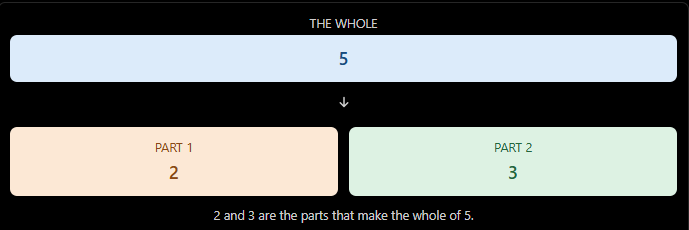
We can make five with two and three, one and four, or five and zero. The whole remains five, even though the parts change.
This is an important discovery for children. Numbers aren't just symbols on a page. They represent quantities that can be separated, combined, and compared in different ways.
Last week, we talked about using ten frames to help children visualize quantities and build number sense. We can continue building on that understanding, but now our focus shifts to identifying the parts that make a whole and recognizing when one of those parts is missing.
Why the Missing Part Can Be So Tricky
Consider these two problems:
3 + 2 = 5
3 + __ = 5
The first problem gives children both parts and asks them to find the whole. The second gives them one part and the whole, asking them to determine the missing part.
Although the problems are closely related, the thinking required is different.
If a child understands that five is the whole and three is one part, they can begin to reason: "I have three. How many more do I need to make five?"
They might use counters, fingers, or objects to find the answer. With practice, they may begin to recognize the relationship without needing to count every object.
The goal isn't simply to teach children how to fill in the blank. It's to help them understand why the missing number must be two.
That distinction matters. When children understand the relationship between the parts and the whole, they have a foundation they can use across many different types of math problems.
Activities to Try at Home
You don't need worksheets or special materials to practice part-part-whole. Everyday objects provide plenty of opportunities.
1. Make a whole with objects
Gather five blocks, crackers, toy cars, or other small objects. Separate them into two groups. Ask your child how many are in each group and how many there are altogether.
Then cover one group and ask, "There are five altogether, and you can see two. How many are hiding?"
2. Play the missing-part game
Tell your child you have six objects altogether. Show them four, keeping the others hidden. Ask, "How many do I have hidden in my hand?"
Let your child use whatever strategy helps them figure it out. As they gain confidence, change which part is hidden and use different whole numbers.
3. Connect the parts to a number line
A number line offers another way to see the relationship. Start at three and ask how many jumps it takes to reach five. Children can physically move a counter or point along the line.
This helps them see that the missing part represents the distance between the known number and the whole. The same idea can later support subtraction and more advanced number work.
As children become comfortable with these activities, vary your questions. Sometimes give them both parts and ask for the whole. Other times, give them the whole and one part, and ask them to find the missing part.
That flexibility helps children develop understanding rather than memorize a single procedure.
From Part-Part-Whole to Number Lines
Number lines help make these relationships visible in a different way. When children see that moving from three to five takes two jumps, they can connect the missing part to the distance between the numbers.
This gives them another strategy to use when solving problems. Instead of relying on counting everything from the beginning, they can start with what they already know and figure out what is missing.
Over time, these ideas will also prepare children for fact families, where the same three numbers can be used to write related addition and subtraction equations. We'll explore that connection in a future blog.
E3 Takeaway
When children struggle with missing-number problems, it can be tempting to give them more practice with addition facts. Sometimes, though, what they really need is a stronger foundation in how numbers work together.
Part-part-whole helps children understand that a number can be broken into parts, that those parts combine to make a whole, and that a missing part can be found when the other information is known.
These are the building blocks of flexible mathematical thinking. When children understand the why behind the numbers, math becomes more meaningful and easier to apply to new situations.
From the Teacher's Desk
One of the most valuable things we can do as teachers and parents is slow down enough to make sure children understand what the numbers represent. We don't have to rush toward memorizing facts or completing problems quickly.
Give children objects to move, opportunities to explain their thinking, and time to work through a problem. Ask questions that encourage them to notice relationships rather than immediately supplying the answer.
A firm foundation in number sense makes room for so much growth. When children understand how numbers fit together, they're better prepared to tackle the math concepts that come next.
